Historic Imperial Markets: Nuremberg and Strasbourg
The Christmas market tradition as practiced across Central and Western Europe did not begin as an aesthetic holiday festival, but as essential late-autumn trade provisions chartered by Holy Roman Emperors and urban bishoprics.
In cities like Nuremberg and Strasbourg, early winter gatherings allowed citizens to stockpile winter preserves, cured meats, woolens, and spices brought along imperial trade routes connecting Venice with the North Sea. Understanding these origins provides an authentic appreciation for the strict guild ordinances that still govern their stalls today.
The Architecture of Nuremberg’s Hauptmarkt
Nuremberg’s Christkindlesmarkt is world-renowned for its steadfast refusal to modernize its physical infrastructure. Every timber booth is constructed from regional spruce lumber, measuring standard dimensions and covered with traditional red-and-white striped cloth canvas. Artificial plastic fir branches, electronic music broadcasts, and fiberglass promotional figures are prohibited by municipal statutes.
At the center of the culinary heritage sits the Elisenlebkuchen. Unlike standard gingerbread, authentic Elisen wafers must contain at least 25 percent tree nuts (almonds, walnuts, and hazelnuts) and no more than 10 percent grain flour. First developed by Franconian monastic communities, the confection utilizes precious spices—cinnamon, cloves, allspice, and mace—that arrived via Nuremberg’s historic trade networks.
Another genuine specialty is the Zwetschgenmännle, whimsical miniature figurines fashioned from dried prunes, figs, walnuts, and birch twigs. Originally created in the eighteenth century by a Nuremberg wiremaker who made toys for neighborhood children while ill, they remain handcrafted items representing chimneysweeps, bakers, and kings.
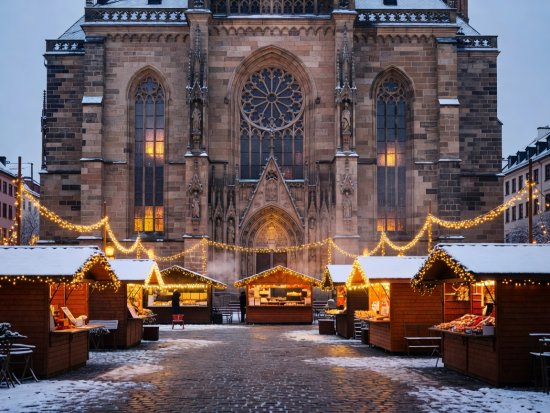
Strasbourg: The Christkindelsmärik Since 1570
In 1570, under the influence of the Protestant Reformation led by preacher Johann Flinner, Strasbourg’s municipal council dissolved the traditional Saint Nicholas market and instituted the Christkindelsmärik (the Market of the Christ Child). This historical pivot transformed the plaza surrounding Place Broglie into one of the earliest recorded secular winter gatherings in Europe.
Today, the market spans across eleven contiguous squares within the UNESCO-listed Grande Île. The Vosges mountain range provides thousands of fresh pine boughs that adorn the eaves of seventeenth-century timber houses along Rue Mercière and Place de la Cathédrale. Guild members serve hot Alsatian apple juice with cinnamon, mannele (soft milk-bread figures eaten on advent mornings), and traditional bredele butter biscuits flavored with aniseed and orange zest.
Alsatian Guild Regulations
The city of Strasbourg enforces strict vendor vetting committees each autumn. Craftsmen must produce their merchandise within the Grand Est region or adjacent historic trading partners, ensuring authentic woodturning, ceramic pottery from Soufflenheim, and hand-dipped beeswax candles.
Navigating the Grande Île
Pedestrian access during advent is carefully controlled to preserve the peaceful ambiance of the medieval quarters. Travelers are advised to navigate via the central tramway (Lines A and D to Homme de Fer) before proceeding on foot across the stone bridges over the River Ill.
Comparing the Imperial Traditions
| Historical Attribute | Nuremberg (Hauptmarkt) | Strasbourg (Place Broglie & Cathédrale) |
|---|---|---|
| First Recorded Charter | 1628 (Documented craft evidence to 1530) | 1570 (Reformed Christkindelsmärik charter) |
| Architectural Setting | Late Gothic Frauenkirche & Schöner Brunnen | High Gothic Vosges Pink Sandstone Minster |
| Signature Confection | Elisenlebkuchen (Nuts $\ge 25\%$, Flour $\le 10\%$) | Bredele biscuits & Kugelhopf yeast cakes |
| Traditional Craft Item | Zwetschgenmännle (Dried fruit figurines) | Soufflenheim pottery & hand-blown glass |
| Warm Beverage Profile | Frankish Spiced Glühwein with blueberry notes | White Alsace Vin Chaud with star anise & citrus |